
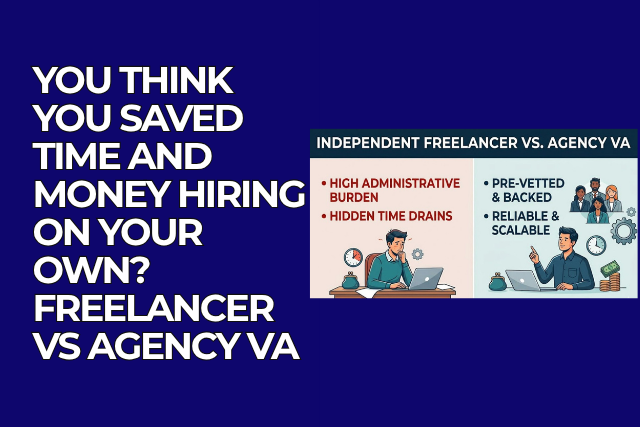
1. Introduction: The Illusion of Efficiency
At first glance, hiring a freelancer independently appears to be a pragmatic decision. Lower rates. Direct communication. Immediate engagement. It feels efficient—almost deceptively so.
Yet efficiency is not always what it seems. Beneath the surface lies a lattice of unseen responsibilities, incremental time drains, and fragmented processes. What begins as a cost-saving measure can gradually morph into a complex operational burden.
The paradox is subtle. In trying to save time and money, many business owners inadvertently expend more of both.
2. The Appeal of Hiring Freelancers Independently
The allure is undeniable. Freelancers offer accessibility and autonomy. There is no intermediary, no layered structure—just a direct working relationship that feels agile and uncomplicated.
Costs are typically lower, at least nominally. This creates an immediate sense of financial prudence. Add to that the flexibility of scaling hours up or down, and the model appears almost tailor-made for growing businesses.
Communication, too, seems more fluid. Messages are exchanged directly. Instructions are delivered without dilution. For many, this simplicity reinforces the belief that independent hiring is the optimal route.
But simplicity can be misleading. What appears streamlined at the outset often conceals operational intricacies that surface over time.
3. The Hidden Time Drain Behind DIY Hiring
Hiring independently is not a singular task—it is an ongoing process. It begins with sourcing candidates, sifting through applications, and conducting interviews. Each step demands attention, discernment, and time.
Then comes onboarding. Systems must be explained. Processes documented. Expectations clarified. This phase alone can consume hours, sometimes days.
Management does not end there. Performance must be monitored. Feedback must be provided. Issues must be addressed. The cumulative effect is significant.
These responsibilities rarely appear in initial calculations. Yet they persist, quietly eroding the very time the hire was meant to reclaim.
4. The Real Cost of “Saving Money”
Lower hourly rates can be compelling, but they do not tell the full story. Financial efficiency is not determined solely by what is paid—it is defined by what is produced.
Inconsistent output can necessitate rework. Miscommunication can delay progress. Turnover can reset the entire process, requiring rehiring and retraining.
There is also the opportunity cost. Time spent managing these variables is time not spent on strategic growth, client relationships, or revenue-generating activities.
Savings, in this context, become illusory. The apparent economy gives way to a more complex and often more expensive reality.
5. Agency VA: A Structured Alternative
An agency-backed virtual assistant introduces a different paradigm—one rooted in structure, consistency, and support.
Talent is pre-vetted. Skills are assessed before engagement. This eliminates much of the uncertainty inherent in independent hiring.
Processes are already in place. Onboarding is streamlined. Expectations are standardized. The transition from decision to execution is markedly more efficient.
Beyond the individual assistant lies an operational framework. Oversight, quality control, and administrative support are embedded within the system. This infrastructure transforms virtual assistance from a transactional arrangement into a cohesive service.
6. Reliability, Continuity, and Peace of Mind
Reliability is often underestimated until it falters. With freelancers, continuity depends on a single individual. Availability fluctuations, unforeseen circumstances, or shifting priorities can disrupt workflow.
Agencies mitigate this vulnerability through redundancy. Backup support is available. Tasks are monitored. Accountability is institutional rather than individual.
This continuity fosters stability. Work progresses uninterrupted. Deadlines are met with greater consistency.
Over time, this reliability compounds. It builds trust. It reduces friction. It creates an environment where operations run with quiet precision.
6.5 Data Security and Operational Protection
Another critical factor often overlooked in independent hiring is data security.
When working directly with freelancers, businesses frequently share sensitive information—client records, internal systems, passwords, financial documents, and operational processes—without the safeguards of a structured support system. In many cases, protection depends solely on personal trust.
Agency-backed virtual assistants operate within a more secure and accountable framework.
Reputable agencies implement structured protocols for confidentiality, data handling, and access management. Virtual assistants are trained not only in operational tasks but also in professional standards surrounding privacy, security, and compliance. Agreements, monitoring systems, and internal oversight create additional layers of protection that independent arrangements often lack.
There is also greater continuity and control. If staffing changes occur, agencies can facilitate smoother transitions while maintaining operational integrity and protecting business information. Access management, documentation, and workflow continuity are handled more systematically.
As businesses scale, data protection becomes more than a technical concern—it becomes a matter of trust, reputation, and long-term sustainability.
In that context, security is not merely an added feature of agency support. It is part of the infrastructure that allows businesses to grow with greater confidence.
7. Scalability: When Growth Exposes the Cracks
Growth is revealing. It magnifies inefficiencies and exposes limitations.
Freelancers, constrained by their individual capacity, may struggle to keep pace with increasing demands. Scaling often requires adding more freelancers, each introducing new layers of coordination.
Agencies, by contrast, are designed with expansion in mind. Additional support can be integrated seamlessly. Workflows adapt without disruption.
Delegation becomes fluid. Processes remain intact. Growth is supported, not hindered.
This distinction becomes critical as businesses transition from maintenance to expansion.
8. What Business Owners Often Overlook
In the pursuit of efficiency, the focus often narrows to immediate costs. Broader considerations—systems, scalability, sustainability—are sidelined.
There is a tendency to prioritize individuals over infrastructure. Yet it is the system, not the individual, that determines long-term success.
Strategic delegation is not merely about offloading tasks. It is about constructing a framework that enables consistent execution and future growth.
Overlooking this distinction can lead to stagnation. Recognizing it can catalyze transformation.
9. Conclusion: Rethinking What “Saving” Really Means
Saving time and money is a worthy objective. But it requires a comprehensive perspective—one that accounts for both visible and invisible factors.
Independent hiring offers immediacy and flexibility. Agency support provides structure and scalability. Each has its place, but the choice must align with long-term objectives.
True efficiency is not measured by initial savings. It is reflected in sustained productivity, operational stability, and the capacity to grow without constraint.
In the end, the most valuable investment is not the cheapest option. It is the one that endures.
Ready to Stop “Managing” and Start Scaling?
If hiring on your own has turned into more oversight than output, it may be time to rethink the approach. Time is too valuable to spend chasing updates, fixing inconsistencies, or restarting the hiring cycle.
Imagine a different experience:
- Support that’s ready from day one
- Systems that keep everything running smoothly
- A team that grows with your business—not against it
This isn’t just about delegation. It’s about creating operational clarity and momentum.
If you’re serious about scaling, not just staying afloat—let’s make it happen. Receive your FREE consultation with Matt today!