
Introduction
The workplace has undergone a remarkable transformation.
For decades, business success was often associated with physical office spaces filled with employees working side by side. Companies invested heavily in buildings, equipment, and geographic expansion to support growth. The traditional office was considered the epicenter of productivity, collaboration, and innovation.
Today, that perspective is changing.
Advances in technology, shifting workforce expectations, and evolving business needs have redefined how organizations operate. Remote work, once viewed as a temporary solution or employee perk, has become a strategic business model embraced by companies across industries.
More organizations are building remote teams not simply to reduce costs, but to create sustainable systems that support long-term growth, resilience, and competitive advantage.
The companies thriving in today’s business environment are often those willing to rethink how and where work gets done.
1. Access to a Larger Talent Pool
Hiring Beyond Geographic Limitations
One of the most significant advantages of remote teams is unrestricted access to talent.
Traditional hiring confines companies to candidates who live within commuting distance of a physical office. This limitation can dramatically narrow the talent pool and make recruitment more challenging.
Remote work removes these boundaries.
Businesses can recruit exceptional professionals regardless of location, allowing them to focus on skills, experience, and cultural fit rather than proximity.
The result is a broader selection of qualified candidates and stronger hiring outcomes.
Finding Specialized Skills Faster
As industries become increasingly specialized, finding the right expertise can be difficult within a single city or region.
Remote hiring allows companies to search globally for niche skill sets, whether they need project managers, digital marketers, software developers, customer support specialists, designers, or operations professionals.
This expanded reach accelerates hiring and strengthens organizational capabilities.
2. Increased Operational Flexibility
Adapting to Changing Business Demands
Modern businesses operate in dynamic environments.
Customer expectations evolve. Markets fluctuate. Economic conditions shift. Companies must remain adaptable to remain competitive.
Remote teams provide the flexibility needed to respond quickly to changing circumstances.
Organizations can expand support during busy seasons, adjust staffing levels when necessary, and access specialized expertise without making long-term infrastructure commitments.
This adaptability creates a powerful competitive advantage.
Creating Agile and Resilient Organizations
Agility is no longer optional.
Businesses that can pivot quickly often outperform those constrained by rigid structures and processes.
Remote teams encourage decentralized operations, streamlined communication, and greater organizational flexibility.
These characteristics help companies navigate uncertainty while continuing to pursue growth opportunities.
3. Reduced Overhead Costs
Lower Facility and Operational Expenses
Operating a traditional office comes with substantial expenses.
Rent, utilities, office furniture, maintenance, equipment, parking, security, and administrative costs can consume a significant portion of a company’s budget.
Remote teams dramatically reduce many of these expenditures.
While businesses still invest in technology and employee support, overall operational costs are often considerably lower.
This creates opportunities to allocate resources more strategically.
Redirecting Resources Toward Growth Initiatives
Money saved through reduced overhead can be reinvested into areas that directly contribute to growth.
Marketing campaigns.
Technology improvements.
Employee development.
Customer experience enhancements.
Product innovation.
Rather than maintaining expensive facilities, companies can focus their resources on initiatives that generate measurable business value.
4. Higher Productivity and Performance
The Shift From Hours Worked to Results Achieved
Traditional workplaces often emphasize presence.
Remote teams shift the focus toward outcomes.
Instead of measuring productivity by time spent at a desk, organizations evaluate performance based on results, deliverables, and impact.
This outcome-oriented approach encourages accountability and efficiency.
Employees become more focused on achieving objectives rather than simply appearing busy.
Empowering Employees Through Flexibility
Flexibility often leads to greater autonomy.
When professionals have more control over their work environment, they can create conditions that support concentration and effectiveness.
Many employees report fewer distractions, greater focus, and improved work-life integration while working remotely.
The result is often higher engagement and stronger performance.
5. Improved Employee Retention and Satisfaction
Why Professionals Value Remote Work
Workforce expectations have evolved significantly.
Many professionals now prioritize flexibility alongside compensation and career advancement opportunities.
Remote work eliminates lengthy commutes, increases personal autonomy, and allows employees to create schedules that better align with their responsibilities and lifestyles.
These benefits contribute to higher job satisfaction.
Reducing Turnover and Recruitment Costs
Employee turnover is expensive.
Recruiting, hiring, onboarding, and training new team members require substantial investments of time and money.
Organizations that offer remote work opportunities often experience stronger retention rates because employees value the flexibility and trust associated with remote environments.
Retaining top talent strengthens organizational continuity and reduces recruitment costs over time.
6. Business Continuity and Risk Management
Building Resilience During Disruptions
Unexpected disruptions can significantly impact business operations.
Natural disasters. Infrastructure failures. Public health crises. Transportation interruptions.
Organizations that rely entirely on physical offices may find themselves vulnerable during such events.
Remote teams provide a layer of operational resilience.
Because work is distributed across multiple locations, businesses can often continue operating even when localized disruptions occur.
Distributed Teams Create Stability
A geographically distributed workforce reduces dependency on a single location.
This diversification strengthens business continuity and minimizes risk.
Rather than concentrating resources in one office, companies create a more balanced and adaptable operating model capable of weathering uncertainty.
7. Technology Has Made Remote Collaboration Seamless
The Rise of Cloud-Based Operations
The growth of remote work has been fueled by extraordinary technological advancements.
Cloud-based platforms allow employees to access files, systems, and resources from virtually anywhere.
Project management software streamlines workflows.
Communication platforms facilitate real-time collaboration.
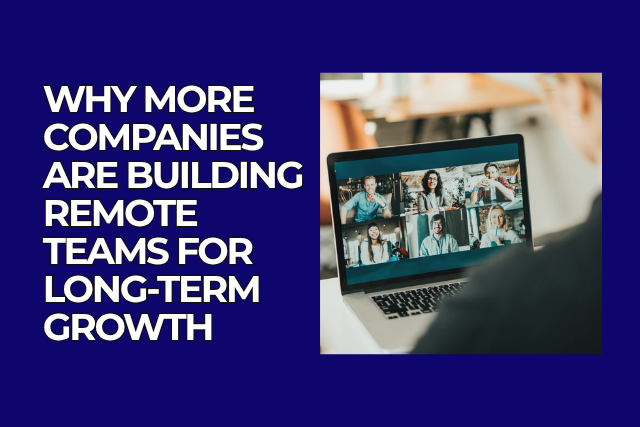
Video conferencing tools connect teams across continents.
Technology has transformed distance into a minor consideration.
Maintaining Communication and Accountability
One common misconception about remote work is that accountability becomes more difficult.
In reality, modern tools often improve visibility.
Tasks can be tracked. Deadlines can be monitored. Performance metrics can be measured.
Clear expectations and structured communication processes allow remote teams to operate with remarkable transparency and efficiency.
8. Remote Teams Support Sustainable Long-Term Growth
Scaling Efficiently Without Infrastructure Constraints
Growth often creates operational challenges.
Traditional expansion frequently requires larger office spaces, additional equipment, and increased administrative support.
Remote teams eliminate many of these constraints.
Organizations can add talent and expand capabilities without making substantial infrastructure investments.
This enables more efficient scaling and supports long-term profitability.
Creating a Future-Ready Organization
The future of work continues to evolve.
Companies that embrace remote teams position themselves to adapt more effectively to changing workforce expectations and technological advancements.
By building systems that support distributed collaboration, businesses create a foundation capable of supporting future growth regardless of market conditions.
Future-ready organizations prioritize flexibility, innovation, and resilience.
Remote teams help make all three possible.
Conclusion
Remote work has evolved far beyond a temporary workplace trend.
It has become a strategic business advantage that allows companies to access global talent, improve operational efficiency, reduce costs, strengthen resilience, and support sustainable growth.
Organizations that embrace remote teams are discovering new ways to scale without traditional limitations. They are building agile structures, empowering talented professionals, and creating systems designed for long-term success.
As technology continues to advance and workforce expectations continue to shift, remote teams will likely play an increasingly important role in the future of business.
For companies focused on sustainable growth, building a remote team is not simply about where employees work.
It is about creating an organization capable of thriving in a rapidly changing world.
Receive your free consultation with Matt today and discover how building the right remote team can help your business scale efficiently, improve productivity, and position itself for long-term success.