
Introduction
1.1 Debunking the “AI vs Humans” misconception
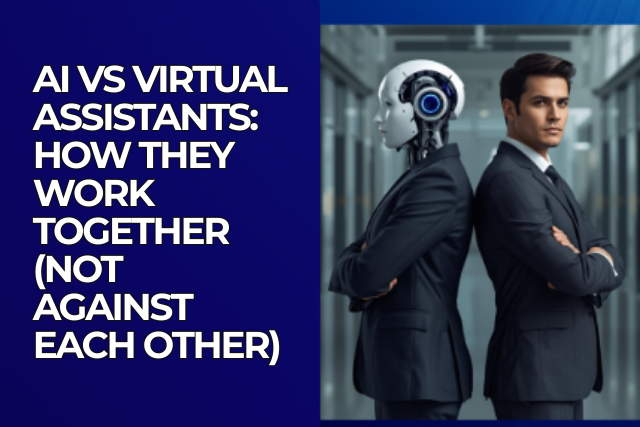
The conversation around artificial intelligence often leans toward conflict — as if humans and AI are locked in competition. This narrative is misleading. AI was never designed to replace the nuances of human intuition. Instead, it enhances productivity by handling repetitive, data-heavy, or time-consuming tasks. When humans and AI work together, the result is profoundly efficient.
1.2 Why collaboration is the future of productivity
Businesses thrive when both technology and talent operate in harmony. AI brings precision and velocity. Virtual Assistants bring empathy, judgment, and relational intelligence. Combined, they create a workflow that is faster, more accurate, and unmistakably human-centered.
Understanding AI’s Strengths
2.1 Automation, speed, and data processing
AI excels in performing high-volume tasks at extraordinary speed. It can process information, extract patterns, and automate workflows with unparalleled consistency. When a business needs rapid sorting, calculating, or categorizing, AI becomes the quiet engine powering efficiency.
2.2 How AI enhances accuracy and repeatability
AI doesn’t tire. It doesn’t forget. And it doesn’t succumb to distractions. This makes it ideal for tasks that demand precision — such as transcription, data entry, and analytics. Its reliability reduces errors and strengthens operational stability.
Understanding a Virtual Assistant’s Strengths
3.1 Empathy, nuance, and human judgment
A Virtual Assistant brings something AI cannot replicate: emotional intelligence. They read tone, interpret subtext, and respond with sensitivity. These qualities are essential when handling clients, managing communications, or navigating delicate decisions.
3.2 Relationship-building and contextual decision-making
VAs understand context — a subtle but rare skill. They know the client’s preferences, brand voice, personal habits, and long-term goals. This knowledge forms the foundation of trust, allowing a VA to act as an extension of the business rather than a simple helper.
Where AI Excels — and Where It Doesn’t
4.1 High-volume tasks AI handles remarkably well
AI shines when given structured, rules-based tasks. It can categorize emails, draft first-pass content, process large datasets, create summaries, and automate routine workflows. These strengths shorten timelines and eliminate bottlenecks.
4.2 Situations AI struggles with emotional or situational clarity
What AI lacks is human intuition. It cannot fully decipher sarcasm, urgency, cultural nuances, or delicate interpersonal cues. When an email sounds frustrated, a client seems unsure, or a decision requires careful diplomacy — a Virtual Assistant’s emotional discernment becomes irreplaceable.
Where Virtual Assistants Excel — and Where They Need Support
5.1 Tasks requiring critical thinking, discretion, or adaptability
Many responsibilities demand a human touch: managing relationships, interpreting complex requests, handling confidential matters, and anticipating a client’s needs before they’re spoken. VAs navigate these with ease, adjusting their approach based on tone, timing, and environment.
5.2 How VAs leverage AI to streamline manual workload
Modern VAs are no longer just assistants — they’re AI-powered productivity partners. They use AI tools to speed up research, create draft content, sort information, manage calendar logistics, and automate repetitive tasks. AI becomes an enhancer, freeing the VA to focus on strategy and problem-solving.
The Symbiotic Workflow Between AI and VAs
6.1 AI as the “first pass” and VA as the intelligent filter
AI can generate the initial version of a task — a draft email, a research summary, or a data breakdown. The VA then refines, humanizes, corrects, and contextualizes it. This partnership results in higher-quality output in a fraction of the time.
6.2 Seamless cooperation in daily operations
In practice, AI handles volume while VAs handle direction. AI speeds up work. The VA ensures accuracy. AI organizes. The VA interprets. Together, they produce a workflow where efficiency meets mindfulness.
Real-World Scenarios Showcasing Collaboration
7.1 Inbox management, scheduling, and communications
AI can sift through emails, categorize them, and flag important items. The VA then responds thoughtfully, schedules follow-ups, and manages conversations. This saves hours while maintaining a warm, professional tone.
7.2 Research, content creation, and data organization
AI collects raw information. The VA transforms it into insights. AI generates content drafts. The VA edits them to align with brand voice and intent. AI structures data. The VA extracts meaning and creates action plans. Each side contributes uniquely to the final product.
Impact on Business Efficiency
8.1 Faster turnaround times
With AI accelerating initial tasks and VAs refining them, projects move at remarkable speed. What once took hours can now be done in minutes — without compromising quality.
Higher quality outputs through human–AI synergy
When technology and human intelligence converge, the work becomes sharper, more accurate, and more thoughtful. The business benefits from heightened productivity and elevated standards.
The Future of Work: VAs as AI-Enabled Partners
9.1 How AI elevates a VA’s capabilities
AI expands what a VA can accomplish. It transforms them into ultra-efficient operators who manage complex responsibilities with greater ease. Their value grows as they integrate new tools and techniques into their workflow.
9.2 Why the human role becomes more strategic, not obsolete
Instead of replacing VAs, AI amplifies their strategic importance. It allows them to focus on deep work — decision-making, planning, communication, and relationship management. The human element becomes the differentiator that technology cannot mimic.
When Intelligence Meets Intuition: AI + VAs in Harmony
10.1 A Unified Force for Modern Businesses
The misconception that AI and Virtual Assistants operate on opposing sides overlooks the dynamic synergy they create. When merged, they function as a unified force—technology handling volume and precision, while humans deliver emotional intelligence and contextual brilliance. This alliance equips businesses with a powerful blend of automation and empathy, enabling them to scale with confidence.
10.2 Why the “Either-Or” Mindset Limits Growth
Choosing between AI and a Virtual Assistant is no longer a strategic debate. Modern success relies on integration, not separation. AI accelerates processes, but a VA interprets goals, people, and situations. The moment businesses stop viewing them as competing entities, they unlock the ability to streamline operations and elevate the human experience simultaneously.
10.3 How Human Expertise Directs AI’s Capabilities
AI performs best when guided by informed human judgment. A VA understands the brand’s personality, client expectations, and strategic priorities—allowing them to direct AI tools with intention and clarity. The result is a workflow where AI executes tasks efficiently while the VA ensures that every output aligns with the company’s voice and goals.
10.4 Creating a Balanced Workflow That Reduces Burnout
When AI absorbs repetitive or high-volume tasks, VAs avoid overwhelm and reclaim time for meaningful work. This reduces burnout, improves accuracy, and encourages a more thoughtful approach to client care. Businesses benefit from smoother operations and happier, more productive team members.
10.5 The Ideal Partnership for Sustainable Growth
The future of efficient business operations isn’t about replacing humans with technology. It’s about pairing AI’s mechanical brilliance with the nuanced understanding of a skilled VA. Together, they create a resilient system capable of supporting growing workloads, enhancing customer experiences, and driving long-term success.